Education is the medium through which an individual is able know and develop the self, a process that culminates in mastery of our habitat. It is the path of least resistance in negotiating
the demands of the human psyche at its diferent levels of development.
The success and longevity of a society is thus determined by the quality of education it offers to its young with the education offered at any specific time defined by the role of human labor
in the value-production process.
To support the evolution of the African Economy from an Agrarian economy to a services based economy,the education sector must be equipped to drive this change.
Project Phoenix represents the path of least resistance in equipping the African education system with capacity to train learners for the new wolrd. We have
-
Identified the school model that best meets the changing curriculum, pedagogical and organizational needs, enabling educators to help their students prepare for the competitive and changing
nature of the workforce by inspiring them to learn and use their talents
-
Defined the most efficient route in implementing the school model in all public schools on the continent increasing the quality of affordable education.
-
Launching a chain-secondary school, powered by our education theseis, to offer an accellerated education to the continents most gifted students.
To effectively unlock the next generation of labour, the African education system needs to evolve in 3 core areas:
Curriculum:What to teach.
For humans to thrive in the age of smart machines, it is essential that they do not compete with machines.While the specifics vary, the general agreement is that repetition,
patern-prediction and recognition, memorization, or any skills connected to collecting, storing, and retrieving information are in decline because of AI and related technologies.
Moreover,given the rapidity of changes we are already experiencing, it is clear that lifelong careers and traditional employment pathways will not exist in the way that they have for
past generations. Jobs and the way we do business will change and the change will be fast.
On the rise is a set of contemporary skills which includes creativity,curiosity, critical thinking, entrepreneurship, collaboration,communication, growth mindset, global competence, and
a host of skills with diferent names.Being unique and equipped with social-emotional intelligence are distinct human qualities that machines do not have. In an AI world, individual
creativity, artistry and humanity will be important commodities that distinguish us from each other.
For this reason, schools can no longer pre-impose all that is needed for the future before students graduate and enter the world.Education must be seen as a pathway to ataining lifelong
learning, satisfaction, happiness, well being, opportunity and contribution to humanity.
Schools therefore need to provide comprehensive access and deep exposure to all learning areas across all years in order to enable all students to make informed choices and develop their
passions and unique talents.While helping students develop basic practical skills is still needed, education should also be about development of humanity in citizens of local, national,
and global societies.
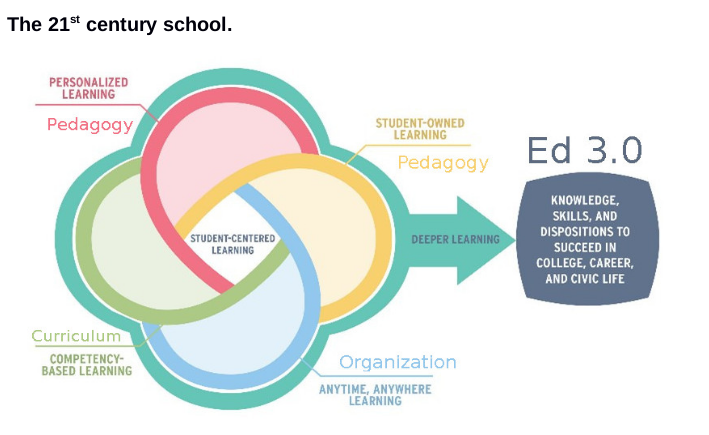
Pedagogy:How to teach.
Schools need to shift from direct instruction for its unproductive successes or short-term successes but long term damages.In its place should be new models of teaching and
learning that are student-centered, inquiry-based, authentic, and purposeful.
The new pedagogiccal models should focus on student-initiated explorations of solutions to authentic and significant problems. They should help students develop abilities to handle the
unknown and uncertain instead of requiring memorization of known solutions to known problems.
Learners need to be more actively engaged in their own learning.Students are diverse and have diferent levels of abilities and interests that may not align well with the content they
are collectively supposed to learn in the classroom.
The movement towards a more personalized mode of learning needs students to become more active in understanding and charting their learning pathways.Teachers must pursue classroom
diferentiation as students take a more active role in defining their learning and learning environments in collaboration with teachers.
Organization:Where and When to teach.
Although technology has made it possible for schools to offer online education for quite some time and the number of students taking online courses has been on the rise, it is not
until the arrival of COVID-19 that the majority of education been offered through this mode.The covid-19 pandemic has ultimately changed one of the most important unwriten school rules:
all students must be in one location for education to take place.
This massive online movement changed the typical. It has forced teachers to experience teaching without proximity to the students.This has given many teachers the opportunity to rethink
the purpose of teaching and connecting with students.
The typical place of learning has been the classroom in a school and the learning time has been typically confined to classes.When students are not learning in classes inside a school,
they are distributed in the community. They can interact with others through technologies. This can have significant impact on learning activities. If allowed or enabled by a teacher,
students could be learning from online resources and experts anywhere in the world. Thus, the where of learning changes from the classroom to the world.Furthermore, the time of learning
also changes.
When learning goes online and students are not or do not need to be in schools, their learning time vastly expands beyond the traditional school time.They can learn asynchronously at anytime.
Equally important is that their learning time does not need to be synchronous with each other or with that of the teacher.To produce graduates literate in the workings of a globalized world,
the education sector must redefine where and how education is offered.
Specialized Education under Education 3.0
Society often neglects the children and the people that have some kind of learning disabilities. Due to this, most of the time they receive negative feedback from their schools and could not
be able to develop any kind of positive atitude to the outside world yet it is the right of every child to receive equal and same opportunity for receiving basic education.
Competency based education is geared towards nurturing every learner's potential ensuring no learner is left out. The Basic Education Curriculum Framework demands for a diferentiated
curriculum for learners with special needs who may follow the regular curriculum with adaptations and those who may require a specialized curriculum
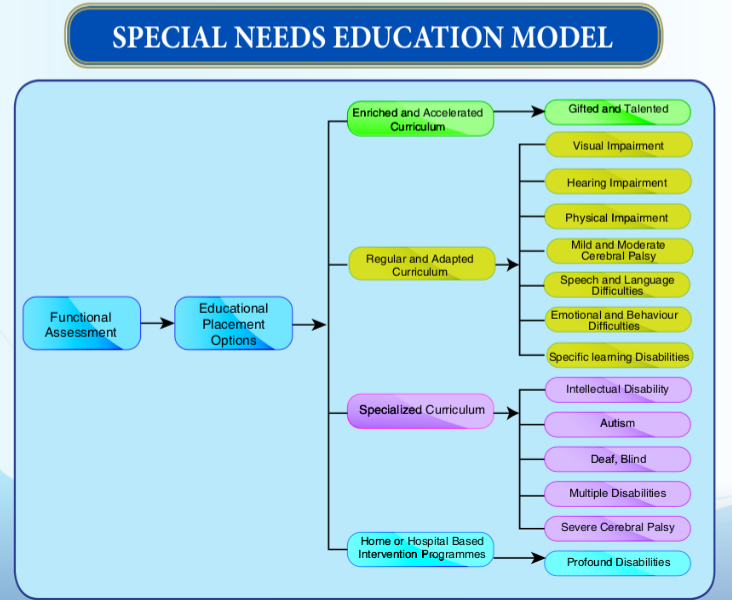
Special education encompasses the policies and programs in an education system especially designed for the children that are gifed or handicapped, that have any kind of mental, physical or
emotional disabilities. They require special type of teaching approaches,care and equipment that can be used both within and outside the regular classroom.
Meeting the Needs of Gifted Learners.
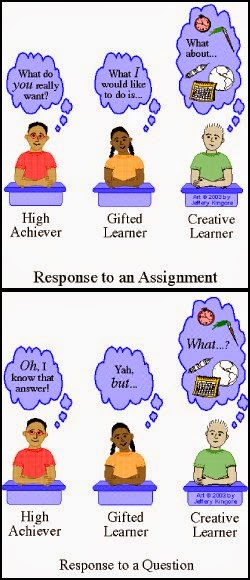
When we hear the term Special Education, many of our thoughts go straight to those individuals with learning disabilities, cognitive functioning disabilities, and what not. However, we do
also have to realize that Special Education encompasses a lot more than those individuals on one end of the spectrum so to speak. Educators and policy makers ofen over look the other end
of the spectrum,the gifed and talented students.
Students placed in these programs do in fact fall under the umbrella of Special Education. While these students may not have learning disabilities, they still require resources outside of
their generalized classrooms and enrichment that they cannot receive from the lead teacher in the classroom.
Gifed children can be described as those children who exhibit precocious development of mentalcapacity and learning potential as determined by competent professional evaluation to the extent
that continued educational growth and stimulation could best be served by an academic environment beyond that ofered through a standard grade level curriculum.
Gifed learners come in a variety of shapes and sizes, but they share a common need,asynchrony;the disparity between cognitive, emotional, and physical development. This defining chararacteristic means
that gifed students can develop unevenly across skill levels.
For example, a gifed child might excel in math but struggle in reading or vice versa. Their cognitive skills might be quite advanced, but other areas of development, such as fine motor or social skills,may be lagging.To best
meet the needs of gifed students, an understanding of individual strengths and areas of concern is needed so that a range of services can be ofered.
What makes a child gifed and talented may not always be good grades in school, but a diferent way of looking at the world and learning,(Grassley)
Phoenix Accelerated School
Phoenix Accelerated School is a K-12 school , based on the education 3.0 school of thought, that exists to provide the environment needed to nurture the best of each gifted student on the continent.
Academically gifed and talented students make up approximately 6-10% of the total student population. These students diferr from typical students in terms of learning style, depth and complexity of
understanding, and potential. This diference from the norm for their age group means that the education program for gifed students should be modified to meet their needs.
However, most gifed students receive the majority of their education in a regular classroom, taught by teachers who have not been trained to teach high-ability students. For many gifed
students,much of the time they spend in school is wasted; they have already mastered the material and are marking time until they are allowed to skip a grade or are permited to take
college-level courses.
Gifed and talented students need an academic environment to meet their learning needs so they can make continuous progress in school. They need
- A curriculum that will challenge them in regular classroom setings.
- Enrichment
- Accelerated learning opportunitiesIV. Appropriate social and emotional support.